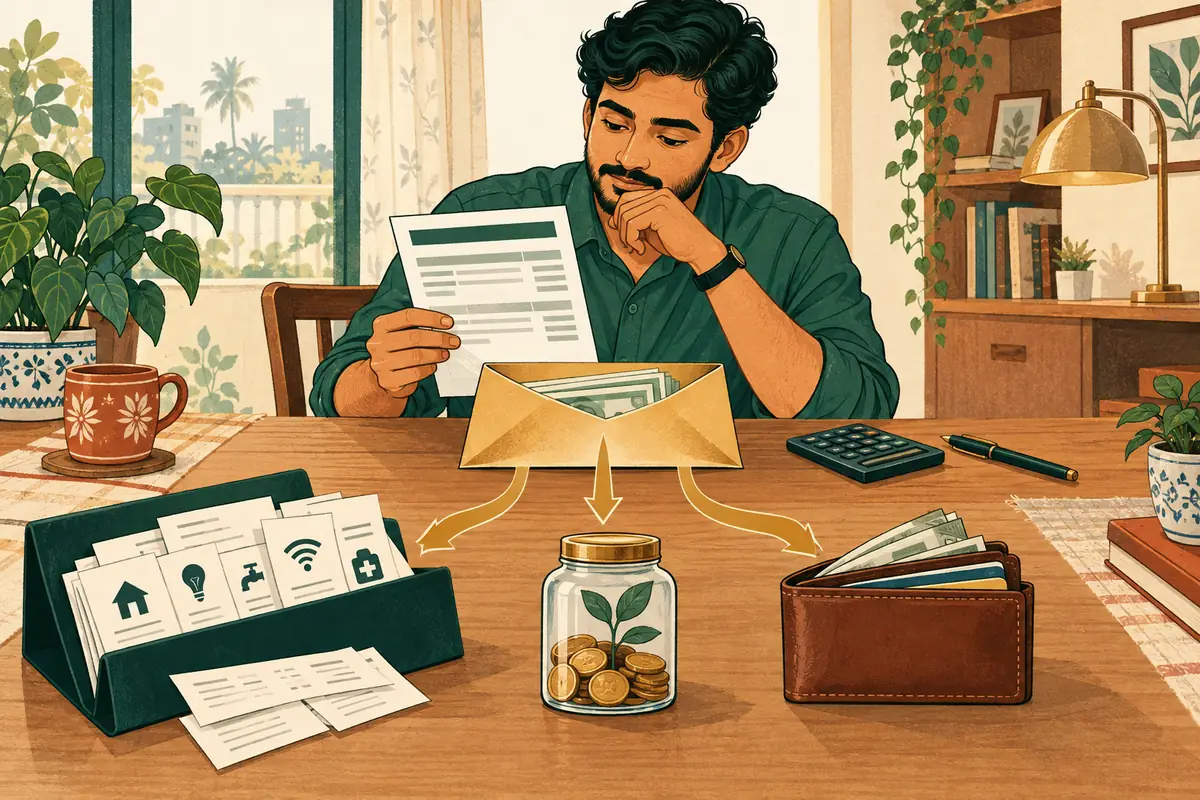
The fear is earning more than before and still reaching the end of the month with nothing. The extra ₹5,000 can disappear into a higher rent, family needs or an EMI before you notice it. Keep one rule: give the salary a job before spending begins. A planned small saving is more dependable than a large amount you hope will remain.
A ₹30,000 budget, two ways
Use the amount credited to your account, not CTC. The examples below both total ₹30,000 and include family support, a health-cost allowance and annual bills. They are hypothetical budgets, not city price surveys or insurance quotes. If food is already included in your contribution at home, move that duplicate allowance to savings or another real obligation.
| Monthly category | Living at home | Renting in a city |
|---|---|---|
| Rent or household contribution | ₹6,000 | ₹9,000 |
| Food and groceries | ₹3,000 | ₹4,500 |
| Travel | ₹2,000 | ₹2,000 |
| Phone, internet and utilities | ₹1,000 | ₹1,500 |
| Additional family support | ₹2,000 | ₹2,000 |
| Insurance and health-cost allowance | ₹1,500 | ₹1,500 |
| Wants: outings, shopping, subscriptions | ₹4,500 | ₹3,000 |
| Pot for annual bills and repairs | ₹1,500 | ₹1,500 |
| Monthly unplanned buffer | ₹1,500 | ₹1,500 |
| Saved on salary day | ₹7,000 | ₹3,500 |
| Total | ₹30,000 | ₹30,000 |
The renter saves about 11.7 percent; the person at home saves about 23.3 percent. Neither is a moral score. Rent and household responsibilities explain much of the gap. If your share of rent is ₹13,000 instead of ₹9,000, this renter budget has a ₹4,000 hole. Skipping a ₹100 snack cannot close it. The housing arrangement, another major cost or income needs attention.
For the lower-income sibling of this plan, read saving on a ₹25,000 salary. The same structure applies: essential costs, deliberate wants, a buffer and a transfer made before the rest is spent. A raise should change the allocation deliberately rather than disappearing into a more expensive default lifestyle.
The order to save in
- Keep enough in the spending account for bills due before the next salary. A savings transfer that causes a missed essential payment is set too high.
- Build a starter emergency cushion in an accessible bank account. Even ₹5,000 to ₹10,000 can reduce the need to borrow for an urgent repair.
- Work towards several months of essential expenses, using your actual needs rather than a multiple of gross salary.
- Address costly revolving debt with a realistic repayment plan before increasing risky investments.
- Once the foundation is stable, consider a small long-term SIP and increase it as your income and buffer allow.
In the renter example, the first six rows total ₹20,500 of essential monthly commitments. Three months would be ₹61,500 before adding any other essential obligation. That is a longer project, not a target you must reach by next month. The emergency fund guide explains why this money needs to remain available when things go wrong.
Annual bills are not emergencies
The ₹1,500 monthly annual-bill pot becomes ₹18,000 over twelve months before interest. Use it for predictable costs such as a yearly premium, travel home, necessary repairs or fees. List the actual bills and dates, then divide the total by the months available. If a premium is due in two months, dividing it by twelve today will leave you short.
Keep this pot separate from the emergency fund, even if you track both in a single bank account using a ledger. The monthly unplanned buffer has a third job: absorbing small variations in groceries, transport or medicine. At month-end, move any unused buffer to the emergency fund rather than treating it as a signal to spend more.
What actually moves the needle
- Compare housing and commuting together. A cheaper room that creates expensive daily travel may save less than it appears.
- Set the savings transfer shortly after confirmed salary credit, then leave enough for scheduled bills.
- Review recurring payments and cancel only those you do not value. Avoid replacing one unused subscription with another annual commitment.
- Plan weekday meals and a realistic eating-out allowance. Include the cost of groceries when calculating what reduced delivery really saves.
- Keep phone and gadget purchases within a planned fund. An EMI is still spending even when the offer calls it no-cost.
If debt is the main pressure, the minimum-payment trap guide explains why a small required payment may not clear the balance quickly. Keep a small cash cushion while making an affordable debt plan. Do not borrow again merely to display a savings balance in a different account.
The first ninety days, realistically
In month one, track the existing outgoings and choose a salary-day transfer you can sustain. In month two, correct one large mismatch, perhaps rent, commuting or debt payments, and start funding annual bills. In month three, compare what you planned with what actually remained. Increase the transfer only if doing so will not create an overdraft or another loan.
At ₹3,500 saved each month, three months builds ₹10,500 before interest if you do not need to use it. At ₹7,000, the same period builds ₹21,000. A ₹30,000 cushion takes about nine months at ₹3,500, or five months at ₹7,000. These are contribution calculations, not investment-return forecasts.
When the foundation is ready, starting a SIP with ₹500 explains a small beginning for long-term money. Keep near-term fees, medical costs and emergency cash outside equity. The point is a system you can repeat through ordinary months, not an impressive first transfer that must be withdrawn a week later.
What to do next
- Write a budget from the ₹30,000 actually credited, including annual bills.
- Set a sustainable salary-day transfer to an accessible emergency fund.
- Review the first three months and fix one large cost before raising the target.